Your brokerage website is getting less traffic – here's why
Your brokerage website is getting less traffic. Here's what's actually happening – and what to do next.



In late 2024, HubSpot quietly disclosed something that made every single marketer stop and pay attention. One of the most established content and SEO operations on the internet – the company that literally wrote the playbook on inbound marketing – had lost the majority of its organic web traffic.
This wasn’t a simple misstep due to a bad campaign, or due to a competitor outranking them. Simply put, the rules of the internet had changed, and their strategy hadn't caught up.
If it could happen to HubSpot, it's either already happening to your brokerage, or it will be soon. The good news is that the brokerages paying attention right now have a real window to get ahead of it.
Sooo… what's actually going on?
The instinct when traffic drops is to look inward – a broken page, a Google penalty, a developer error, etc. But the traffic decline most brokerages are experiencing today isn't an internal problem; it's a structural shift in how the internet works.
For most of the past decade, the search funnel was simple: someone types a question into Google, clicks a result, and lands on your website. That chain is breaking.
Research tracking zero-click search behavior shows that roughly 60% of Google searches now end without any click to a website at all. Most users get what they need directly on the search results page – whether that’s from AI summaries, featured snippets, knowledge panels, and other Google-native answers – and never feel compelled to visit the actual source. That figure has climbed steadily since 2017, and shows no sign of reversing.
Google's AI Overviews feature, which launched in 2024, has accelerated this. According to Seer Interactive, organic click-through rates dropped 61% year over year on queries where AI Overview appeared. The page ranking first still ranks first – it just gets a fraction of the clicks it used to.
And it's not just search – social platforms, which once were a boon to external sites by sending them meaningful traffic, have largely stopped doing so. Meta's own data shows that views of Facebook posts containing links have declined by close to 50% over the past two years. Platforms want users to stay on-platform, and their algorithms reflect that priority.
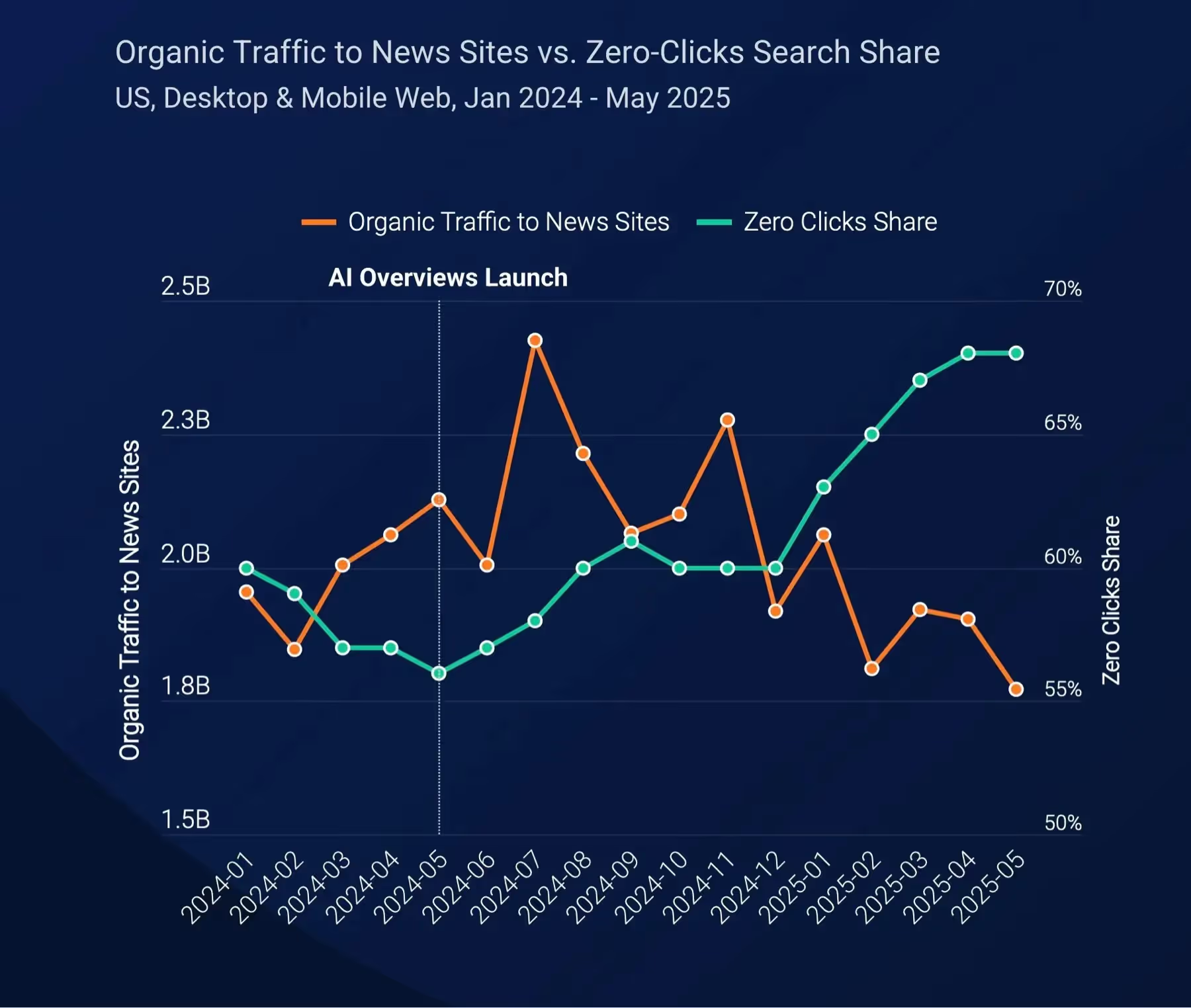
Source: TechCrunch
The result is what some analysts are calling "the great decoupling" – search volume is up, but the clicks that used to follow it are going elsewhere.
Why this matters specifically for real estate brokerages
You might be thinking, “Fine, but that's a media publisher problem – real estate is different.”
It is different… but not in the way you'd hope.
Real estate actually has one of the lowest rates of AI Overview appearances across industries, sitting at around 5.8% of real estate queries according to Ahrefs data. That might sound like good news, but the queries most affected by AI are informational ones – exactly the kind that drive top-of-funnel traffic to brokerage websites (ex. "Best neighborhoods in [city] for families," "How much house can I afford," "What does a buyer's agent actually do?"). If you've built your content strategy around answering those questions, that content is quickly losing its audience.
Meanwhile, consumer behavior is moving fast. A Realtor.com survey found that 82% of consumers are already using AI to research the real estate market, with most gravitating toward ChatGPT and Gemini. Meanwhile, Redfin survey data suggests that roughly 1 in 5 homebuyers under 40 have already used AI as part of their home search. These buyers are forming impressions, narrowing their options, and in some cases, making contact decisions before they ever reach a brokerage website.
There's also a significant investment problem sitting in the background. Metricus estimates that the US real estate industry spent around $13 billion on digital advertising in 2024. The overwhelming majority of that spend is optimized for Google rankings and portal placements – channels that are slowly but surely losing their grip on the top of the funnel. The fastest-growing discovery channel, AI, has no paid ad slots to buy and no playbook most brokerages are following yet.
The buyers are moving – but the budget hasn't followed them.
The opportunity hiding in the decline
Here's where the narrative shifts.
Most brokerage leaders haven't internalized any of this yet. The decline is real, but it's quiet – it shows up as a slow bleed in Google Analytics rather than a sudden crisis, so it's easy to attribute it to market conditions or seasonality. That means the window to move early is still open.
When a structural shift happens and most of the market is slow to respond, the brokerages that adapt first don't just hold their position – they gain ground. Having pioneered the real estate AI space for close to a decade, some of our best-performing clients saw lots of success jumping on the bandwagon before others did.
Competitors pulling back on content investment, neglecting their technical SEO, or continuing to measure success by raw traffic numbers are creating space. The question is whether your brokerage is positioned to fill it.
Understanding your own funnel clearly is a prerequisite. If you're not already measuring conversion by channel, page type, and intent stage (rather than just total visitors), you're operating without the data you need to make good decisions. The brokerage conversion scorecard framework we published is a useful starting point for getting that visibility.
What to actually do about it
1. Stop treating traffic as the primary metric
Raw traffic numbers are increasingly a distraction. A brokerage with 20,000 monthly visitors and a 4% lead conversion rate is in a much stronger position than one with 60,000 visitors converting at 0.8%. As AI changes where clicks go, the brokerages that obsess over conversion quality, instead of just volume, will measure what actually matters.
This also means getting clearer on where your highest-intent visitors are coming from, and doubling down. The following brokerage conversion benchmarks guide breaks down what realistic conversion rates look like across different traffic sources and page types, which gives you a more honest baseline to work from.
2. Build content that AI can't summarize away
The content most at risk is generic, informational content that AI can answer in a sentence, like "What is escrow?" and "How long does closing take?" An AI Overview handles that without breaking a sweat.
The content that holds its value is content only your brokerage can produce: local market data tied to your specific neighborhoods, agent perspectives on current conditions, first-person buyer and seller stories, deal specifics that reflect real transactions in your market. This isn't just SEO positioning – it's content that demonstrates genuine expertise, which both Google and AI systems reward.
3. Optimize for AI citation, not just Google rankings
There's a new discipline emerging called generative engine optimization (GEO) – structuring your content so that AI systems cite your brokerage when answering relevant questions. It's different from traditional SEO, but some of the fundamentals overlap: clear entity definitions, well-structured pages, strong domain authority, and consistent presence on third-party review platforms.
Seer Interactive's research found that when a brand is cited within a Google AI Overview, organic click-through rates are actually 35% higher than baseline. Being present in the AI answer isn't just a visibility play – it also drives more qualified clicks from the users who do follow through.
4. Invest in the channels you own
Search and social are rented audiences – when Google changes an algorithm or Meta changes its feed, your traffic will change with it. Email lists, SMS subscribers, and app-based relationships are owned audiences – you retain access to them regardless of what any platform decides to prioritize.
For brokerages, this means being intentional about collecting direct contact information at every touchpoint and building nurture strategies that keep your audience engaged between transactions. A buyer who found you three years ago through a Google search but stayed on your email list is far more likely to come back (and refer you!) than one who visited once and never converted.
5. Double down on brand recognition
There's one thing AI search and traditional search agree on: if someone searches for your brokerage by name, that's a strong trust signal. Branded searches indicate that a consumer already knows you and is actively looking for you. AI systems are more likely to surface and cite brands with strong reputations, consistent presence across the web, and reviews on credible platforms.
This isn't a new idea – brand has always mattered in real estate – but the digital case for investing in it has never been stronger. Community presence, agent visibility, earned media, and review management all feed into the kind of brand authority that holds up when the search landscape shifts again.
The bottom line
HubSpot's traffic decline wasn't a failure of execution – it was a failure to anticipate structural change in time to adapt. The team was excellent, but the strategy was built for a digital world that no longer exists.
Real estate brokerages are now facing the same kind of inflection point, but the buyers are researching differently. Meanwhile, the platforms are distributing differently. The metric that used to tell you your digital strategy was working, such as monthly website visitors, is a less reliable signal than it used to be.
The brokerages that come out of this period in better shape won't be the ones that got their old traffic back. They'll be the ones that understood what changed, measured what actually matters, and showed up in the right places before everyone else figured out where those places were.
Interested in how Roof AI helps brokerages convert the visitors they do get into qualified leads and booked appointments? See how it works.