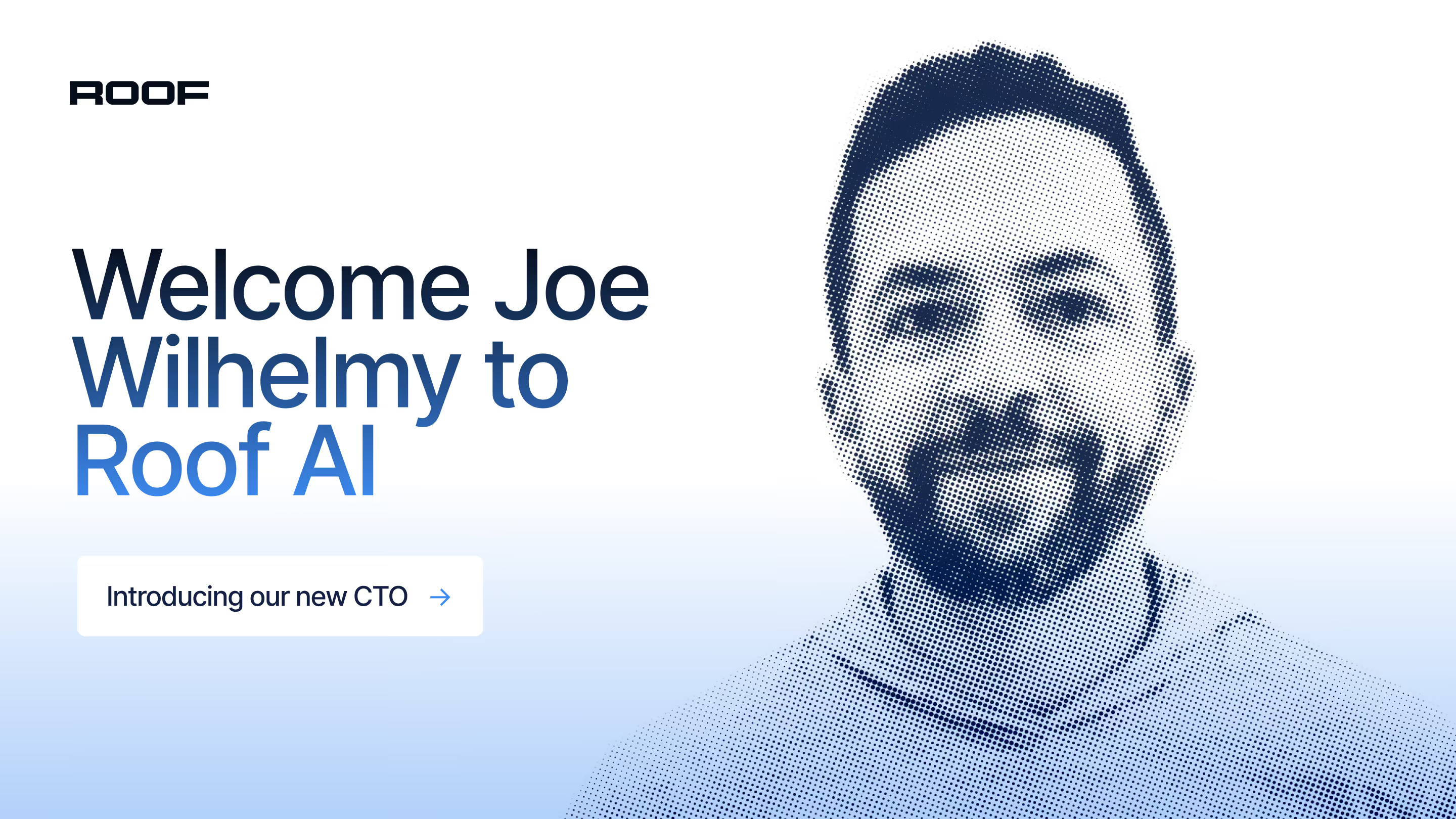
Meet Roof AI's new CTO, Joe Wilhelmy
Joe Wilhelmy joins Roof AI as Chief Technology Officer. A conversation about his career in real estate, data, and AI.


In the dim early light of a crisp Colorado morning, my interviewee appears in the Slack huddle window. We exchange pleasantries, share stories and hobbies, the usual. I’m a few hours ahead in Montreal – the birthplace of Roof AI nearly a decade ago – with my notes in hand. I place them down and nod as he takes me through how we got here.
His name is Joe Wilhelmy, and he’s the person we’ve tasked with steering our product vision as the new CTO of Roof AI. His isn’t an unfamiliar name, however – he was instrumental in one of Roof’s most celebrated partnerships, after all, having worked as the previous VP of Engineering at REMAX.
Joe is an evangelist for tech systems – in that same role, he was on the board of Real Estate Standards Organization (RESO). So it makes sense he ended up at Roof, where three things that have shaped his career – real estate, data infrastructure, and AI – meet.
A career spent close to the data
When Joe started at Keller Williams in the early 2000s, it was a time when an agent’s real estate website came in a literal HTML kit that was emailed out. He eventually took over KW’s profit-share platform, the engine behind their recruiting and commission model, which gave him a window into how the industry actually runs: every transaction, every office, every dollar.
He was also there for the early days of digital real estate: working on listing syndications with Zillow and Trulia, helping launch KW.com as one of the first brokerage-hosted listing experiences at that time.
It was a move to Colorado that took him to AAIS, where he led work on OpenIDL (now OpenIDS), an open-source data exchange standard built in partnership with IBM. Even in a different industry, the problem he and his team were solving are familiar to anyone working in real estate: an industry that runs on data, with no agreed-upon way to share it.
In 2021 he came back to real estate, this time at REMAX, where he led enterprise architecture for a team of 40 that spanned data engineering, API services, and business intelligence. His team built the tech behind everything REMAX customers and agents touched online.
And yes, that includes us at Roof AI.
A quick detour through Santa Fe
Before we continue, I just had to share a story Joe told me that, more than anything else he shared, told me what kind of CTO we'd just hired.
A couple of weeks before he started, Joe and his wife took a trip to Santa Fe. The concierge at their resort was impressed with Joe's personal assistant, who had been emailing back and forth, making dinner reservations and sorting out the week's itinerary. At some point during the stay, the concierge asked Joe where he'd found the guy.
"I built him," Joe said.
Joe had spun up the agent for fun, given it a name, its own Google account, and let it manage his trip.
Now imagine what he's going to do with a real product team.
The biggest misunderstanding about AI in real estate
I asked Joe what he thinks people get most wrong about AI in this industry. He didn’t bring up hype or hallucinations – his answer was about the importance of precision:
AI gets treated like one thing. It isn't. Lead enrichment, qualification, personalization – that's a specific category, and it's not what most of the AI tools people are talking about are actually built to do. The challenge for any organization bringing this to their customers is figuring out whether they have the right tool for the job, or just an AI tool.
He's also got an idea on where this is all headed. He said that a lot of the AI being marketed to agents right now – content creation, video tours from photos, listing copy – will get absorbed into the foundation models within a few years. The defensible work, in his view, is narrower and deeper.
If a foundation model is going to do it out of the box in two years, that's not where we should be spending our build cycles. The defensible work sits where the general models can't reach – proprietary data, real workflow depth, the specifics of how this industry actually runs.
It's a thesis we share at Roof AI – and it's one of the bigger reasons we wanted him in this seat.
Why Roof
Joe's pitch on why he made the move says it best:
I like what Roof is. I think I'd like even more what Roof could be.
He wanted a small, scrappy team. People he could learn from. And, after years in the corporate world, the timing felt right to take on something new. From our side, hiring someone who had already worked alongside our product, and who had clear, hard-won opinions on where real estate AI is and isn't going, was a no-brainer
What's next
Joe's first focus is getting close to the team, the product, and our customers. From there, he's leading the work on what the next chapter of Roof AI looks like – not just the product we have today, but the one we're building tomorrow.
As our hour came to a close, Joe said he had to get going – another call, another introduction, another corner of Roof AI’s many intricacies to get acquainted with. The hour had flown by, and with it, I got to understand a little more about our latest hire. His experience is certainly impressive, but it’s his candor that really stands out.
I’m excited about the future of our scrappy little company, and with Joe at the helm, I know our product is in good hands.